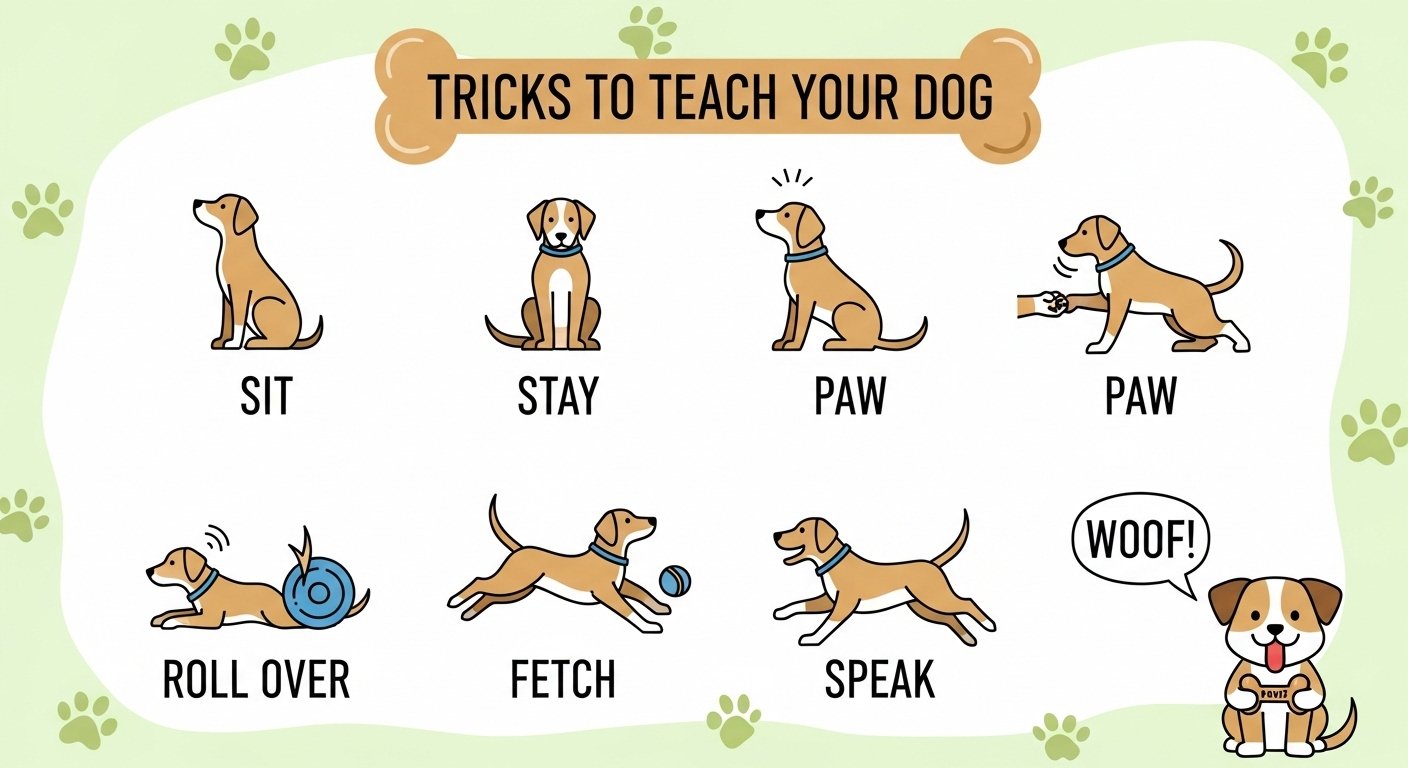
Teaching your dog fun tricks at home can be a rewarding way to bond and provide mental stimulation. Here are the 8 tricks we’ll cover:
- Give Kiss: A sweet way for your dog to show affection.
- Speak: Get your dog to bark on cue.
- Back Up: Teach your dog to move backward safely.
- Shake Paws: The classic handshake with your pup.
- Wave: An adorable greeting trick.
- Spin: Have your dog twirl in circles.
- Sit Pretty: Balance on hind legs for a cute pose.
- Roll Over: A playful full-body roll.
These tricks are generally easy to teach with positive reinforcement and can be done with minimal equipment like treats.
Benefits of Teaching Tricks
Evidence shows that trick training enhances your dog’s mental and physical health, strengthens your bond, and reduces boredom-related behaviors. It’s a fun activity that keeps both you and your pet engaged.
General Training Tips
Keep sessions short (5-10 minutes), use positive reinforcement, and be patient. Start in a quiet space and ensure your dog is healthy before beginning.
| Trick | Estimated Difficulty | Approx. Time to Learn |
|---|---|---|
| Give Kiss | Easy | 1-2 sessions |
| Speak | Easy | 2-3 sessions |
| Back Up | Medium | 3-5 sessions |
| Shake Paws | Easy | 1-3 sessions |
| Wave | Medium | 3-5 sessions |
| Spin | Easy | 2-4 sessions |
| Sit Pretty | Medium | 4-6 sessions |
| Roll Over | Medium | 4-7 sessions |
Teaching tricks to your dog at home is not only entertaining but also beneficial for their overall well-being. According to experts, incorporating trick training into your routine provides essential mental stimulation, promotes physical activity, and deepens the bond between you and your furry friend. It can help prevent destructive behaviors stemming from boredom and even improve obedience in everyday situations. Plus, these activities are perfect for all ages of dogs, as long as they’re healthy—always consult a vet if your dog has any physical limitations.
In this detailed guide, we’ll explore 8 fun tricks you can teach right at home with simple steps, using everyday items like treats and praise. We’ve drawn from reliable sources to ensure the methods are effective and safe. Remember, consistency and positivity are key: short, enjoyable sessions (ideally 5-10 minutes) will yield the best results. Start in a distraction-free environment, gradually adding challenges, and monitor for any signs of stress or injury.
Why Teach Tricks at Home?
Beyond the fun factor, trick training offers tangible benefits. It challenges your dog’s cognitive abilities, keeping their mind sharp and reducing anxiety. Physically, it encourages movement and coordination, contributing to better fitness. Socially, it fosters trust and communication, making your dog more responsive to commands. And let’s not forget the joy—it turns ordinary days into playful adventures!
Safety and Preparation Tips
Before diving in, ensure your dog is in good health; tricks involving movement could exacerbate issues like joint problems. Use high-value treats for motivation, but avoid overfeeding. Always employ positive reinforcement—praise, toys, or treats—to encourage behavior without frustration. If your dog seems uninterested or tired, pause and try again later. For physical tricks, practice on soft surfaces to prevent slips.
Now, let’s get to the tricks! Each includes step-by-step instructions combined from expert advice, along with tips for success.
1. Give Kiss
This affectionate trick is a crowd-pleaser and easy for most dogs to learn quickly.
- Put a small, dog-safe treat (like peanut butter) on your cheek or hand.
- Say the command “give kiss” and let your dog lick it off.
- Immediately reward with praise and another treat.
- Repeat, gradually removing the treat lure until they respond to the command alone.
Tips: If your dog is shy, start with your hand instead of your face. Practice daily for 1-2 sessions to build association. This trick promotes gentle interaction and can be varied for different family members.
2. Speak
Teaching “speak” helps control barking and adds a fun vocal element.
- Wait for a natural bark (e.g., during play or at the doorbell).
- Say “speak” just before or during the bark, then reward immediately.
- Pair with “quiet” by rewarding silence after a bark.
- Practice in controlled settings to refine the cue.
Tips: For quiet dogs, use excitement triggers like toys. Teach “quiet” simultaneously to avoid excessive barking. This can take 2-3 sessions and is useful for alerting behaviors.
3. Back Up
Useful for creating space, this trick improves spatial awareness.
- Stand in front of your dog in a narrow hallway to limit side movement.
- Say “back up” while stepping toward them gently.
- Reward each backward step with treats and praise.
- Gradually increase distance and practice in open areas.
Tips: Use body language consistently. If they turn, guide with treats. This medium-difficulty trick takes 3-5 sessions and enhances safety around doors or crowds.
4. Shake Paws
A timeless favorite that’s great for greetings.
- Have your dog sit, hold a treat in your closed hand.
- Say “shake” and gently tap or lift their paw.
- When they lift it, grasp gently and reward.
- Repeat, fading the physical cue over time.
Tips: Alternate paws for variety. Keep sessions fun to maintain focus. Easy to learn in 1-3 sessions, it’s a social trick that impresses guests.
5. Wave
Build on shake for an endearing wave goodbye.
- Master shake first, then hold your hand higher/out of reach.
- Say “wave” as they lift the paw without contact.
- Reward the waving motion immediately.
- Practice gradually moving your hand farther back.
Tips: Use visual cues initially. This builds on basics and takes 3-5 sessions. Great for photo ops!
6. Spin
A dynamic trick for energy release.
- Hold a treat near your dog’s nose and lure in a slow circle.
- Say “spin” as they follow, rewarding the full turn.
- Practice both directions (e.g., “spin left/right”).
- Fade the lure for cue-only performance.
Tips: Keep it upbeat to avoid dizziness. Easy in 2-4 sessions, it improves coordination.
7. Sit Pretty
Also known as begging, this poses cutely.
- From a sit, lure with a treat upward to lift front paws.
- Say “sit pretty” and reward the balanced hind-leg sit.
- Hold for increasing durations.
- Add walking on hind legs for advanced fun.
Tips: Ensure strong core; avoid if back issues. Medium difficulty, 4-6 sessions.
8. Roll Over
A classic for playtime.
- Start in down position, lure treat from nose to shoulder.
- Guide over the back for a full roll.
- Say “roll over” and reward partial then full rolls.
- Break into steps for reluctant dogs.
Tips: Use soft ground. Medium, 4-7 sessions; patient repetition key.
Conclusion
Mastering these tricks will bring endless fun and strengthen your relationship. Start simple, celebrate progress, and enjoy the process! If challenges arise, consider professional training.
Key Citations: